The Albaicín is the only medieval Arab quarter remaining in continental Europe. This is not a tourism metaphor: it is 40 hectares of cobblestoned alleyways, walled garden estates with hidden courtyards, mosques converted into churches, and 11th-century Zirid walls. UNESCO declared it a World Heritage Site in 1994. And the best part is that you do not need a guide to discover it. This article gives you a complete walking route, step by step, with every point worth seeing, the timings, and the tips we locals actually use.
This route takes between 2.5 and 3 hours at a relaxed pace, including photo stops, a tea in the Calderería, and the time you need at each viewpoint. The total distance is about 3.5 kilometres, with uphill at the start and downhill at the end. Wear comfortable shoes: this is not brochure advice, it is a real warning.
Step-by-step walk: the self-guided Albaicín route
Starting point: Plaza Nueva (0 minutes)
Start at Plaza Nueva, the heart of the historic centre. From here you have two options to climb up. We recommend the Cuesta del Chapiz: follow the River Darro along the Paseo de los Tristes and turn left when the climb begins. It is the gentlest, most beautiful route and passes through the Carrera del Darro, one of Granada's most photographed streets.
Effortless alternative: If you prefer not to walk up, the C31 bus from Plaza Nueva drops you 2 minutes from the Mirador de San Nicolás. It runs every 8-12 minutes and costs 1.40 € (0.83 € with a Credibús card). But you will miss half the route, which is precisely the best part of the walk.
1. Carrera del Darro and Baños del Bañuelo (10 minutes)
Before starting the climb, take a short detour along the Carrera del Darro. The River Darro on your left, Moorish towers on your right, the Alhambra peering over the rooftops. Halfway along, at number 31, you will find the Baños del Bañuelo: an Arab hammam from the 11th century, the best-preserved in Spain.
Entry costs around 3-5 € and almost always includes a guided visit. The main room has columns with capitals recycled from Roman and Visigothic buildings, and the original ceiling with star-shaped openings for ventilation. You are literally standing on the same floor where Albaicín residents bathed in the year 1000.
2. Cuesta del Chapiz: the climb (20-25 minutes)
Return to the Cuesta del Chapiz and start climbing. It is a steady but not aggressive slope. As you gain height, the views toward the Alhambra improve at every turn. This stretch is where you will take the most photos: balconies with geraniums, white walls, ancient wooden doors.
3. Placeta de San Miguel Bajo (40 minutes)
The first mandatory stop. Placeta de San Miguel Bajo is the square every Granadan carries in their memory: cobblestoned, sheltered, with the Church of San Miguel as a backdrop and trees providing shade in summer. It is where we have breakfast on weekends.
If it is breakfast time or you need a rest, Bar Lara (Placeta San Miguel Bajo, 4) has been the busiest bar on the square for decades. Order a coffee and a mollete roll with crushed tomato and olive oil. If you prefer somewhere quieter, any of the square's terraces is a good option. The atmosphere is pure neighborhood.
4. Calderería Nueva (50 minutes)
Walk up a few more minutes to Calderería Nueva, the street of Moroccan teahouses. It is narrow, lined with shops selling carpets, hookahs, and smelling of mint and almond pastry. One of the most photogenic corners in Granada, and also one of the most packed if you arrive late.
The optimal time is between 10:30 and 11:30. The teahouses have just opened, tourists have not yet arrived in numbers, and you can sit with a Moorish tea and Arab pastries without being rushed. Recommendation: try the mint green tea and the almond-stuffed dates.
5. Plaza Larga: the soul of the Albaicín (1 hour 10 minutes)
If the Albaicín has a centre of gravity, it is Plaza Larga. Not the most beautiful (that is Placeta San Miguel Bajo), nor the most famous (that is San Nicolás). But the most authentic: locals buy their bread here, kids play on the steps of the Arco de las Pesas arch, and the bars have been serving coffee to the same retired regulars for decades.
On Thursday mornings, there is a small market selling fruit, vegetables, and local produce. It is one of the few neighbourhood markets that has not become a tourist attraction. Prices are local prices and nobody looks at you strangely if you just browse.
6. Palacio de Dar al-Horra (1 hour 25 minutes)
Three minutes from Plaza Larga, following the signs from Placeta San Miguel Bajo, is the Palacio de Dar al-Horra. In Arabic, "the house of the honourable woman". It was the palace of Fátima, mother of Boabdil, the last Nasrid sultan. Most tourists walk right past without knowing what it is.
Built in the 15th century, it is one of the best-preserved Nasrid palaces outside the Alhambra. It has an interior courtyard with plasterwork arches, a tower with views over the Albaicín rooftops, and a quiet that is simply impossible to find inside the Alhambra. Entry is free or nearly symbolic. Some days you walk in and you are completely alone.
Approximate hours: Tuesday to Saturday 10:00-14:00 and 17:00-20:00, Sunday morning. Closed Mondays. Confirm before going as hours vary by season. Address: Cuesta de la Victoria, s/n.
7. Mirador de San Nicolás (1 hour 40 minutes)
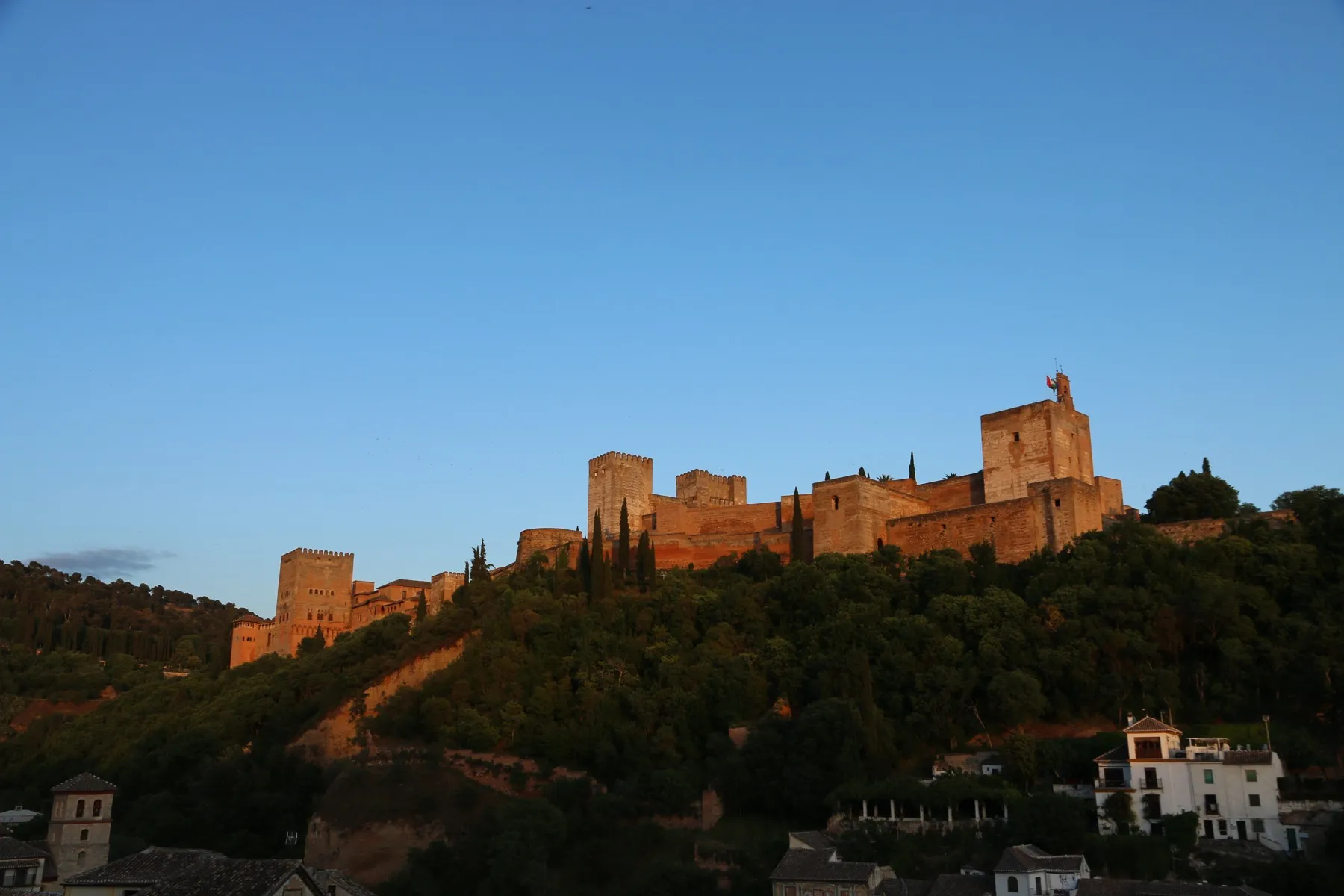
The star moment of the walk. The Mirador de San Nicolás is Granada's most famous view: the entire Alhambra in front of you, Sierra Nevada in the background, the Albaicín at your feet. It is impressive at any time, but at sunset it becomes extraordinary.
Crucial tip: arrive 30-40 minutes before the exact sunset time. Any weather app will give you that. The viewpoint fills up fast and if you arrive right at golden hour, you probably will not find a spot at the railing. Also watch your phone: it is the highest pickpocket concentration in Granada (not dangerous, but the distraction of the view is exactly what they count on).
8. Mirador de San Cristóbal (1 hour 55 minutes)
A 10-minute walk from San Nicolás, climbing a little further east, is the Mirador de San Cristóbal. It is less famous, quieter, and the views are wider: from here you can see the entire Vega de Granada, the villages of the Hoya, and at your feet a stretch of the 11th-century Zirid wall. It is over a thousand years old and many people walk past it thinking it is just any old wall.
9. Descent via Paseo de los Tristes (2 hours 15 minutes)
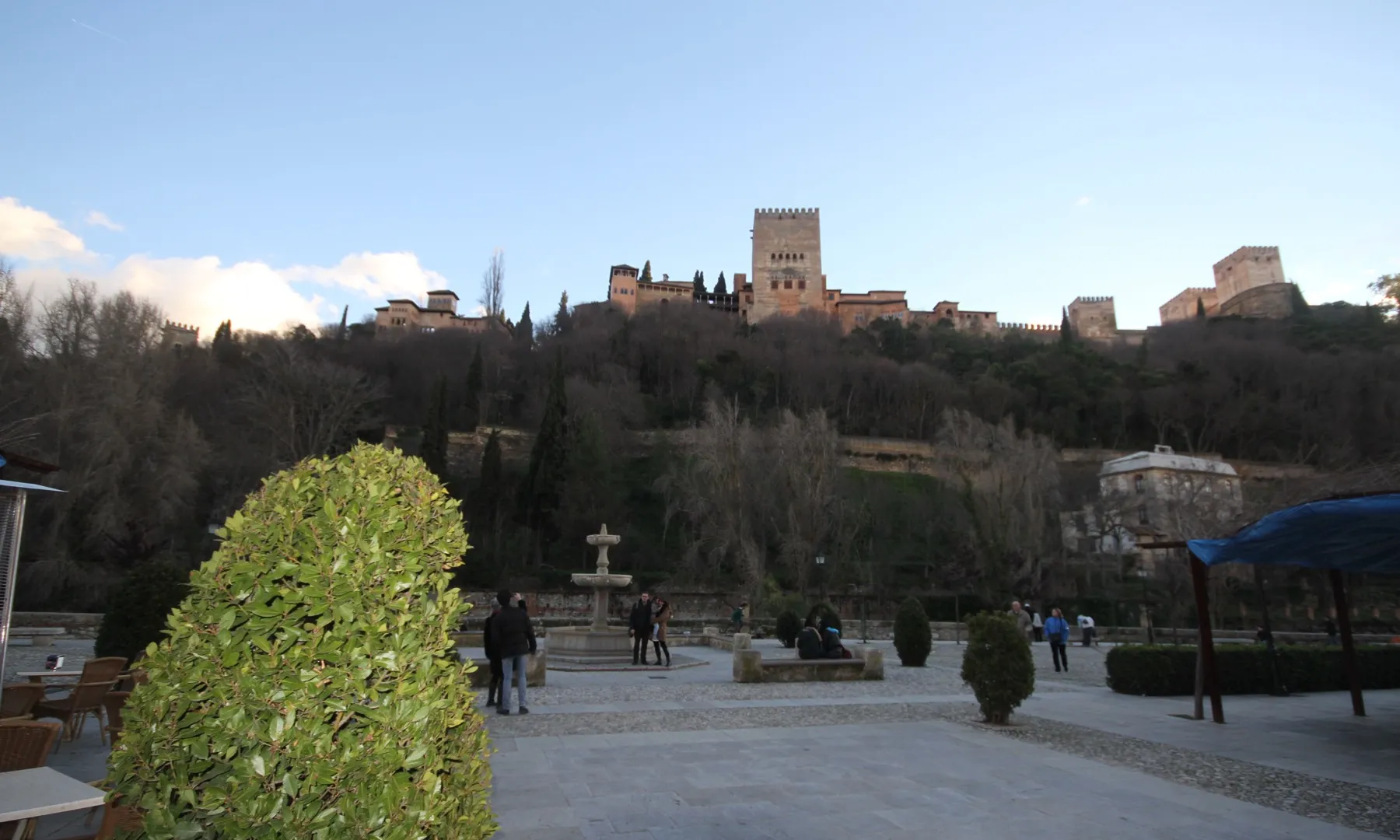
The descent is as important as the climb. From San Cristóbal, head west and go down any of the lanes that lead to the Carrera del Darro. The Paseo de los Tristes, along the River Darro, is probably the most beautiful walk in all of Spain. With the Alhambra lighting up above as the afternoon fades, the terraces full of people, and the sound of water, it is the image of Granada you will carry with you.
Sit down at a terrace, order something cold, and simply look up. You do not need anything else. The Puente del Cabrera, halfway along the promenade, is the best spot for the final photo: the Alhambra, the Darro, the trees, and you.
Practical tips for this self-guided walk
- Rubber-soled shoes are mandatory. The cobblestones and river pebbles are treacherous with flip-flops or smooth soles. People genuinely sprain ankles here.
- Do not use Google Maps to get lost. Keep it to find your way out when you want, but put it away during exploration. The Albaicín rewards the wrong turn: the wrong street usually leads to the right corner.
- Bring water, especially between May and September. The neighbourhood is a heat sponge and there is little shade on the climbs.
- Best time: before 9:30 (you will have the neighbourhood to yourself) or from 18:00 onwards for sunset at San Nicolás. Avoid midday in summer.
- The C31 bus also goes down. If you are tired, you can take the bus from San Nicolás to Plaza Nueva for 1.40 €.
What not to miss along the way
Besides the main points of the route, these are small details that a guide does not always tell you about and that make the difference:
- The cármenes: these are the houses with walled interior gardens. The City Council has catalogued more than 3,000 in the neighbourhood, although most are invisible from the street. Peek over the lower walls whenever you can.
- Convento de Santa Isabel la Real: on Calle Isabel la Real, the Clarisse nuns sell homemade sweets through a rotating hatch in the wall. Roscos de vino, tortas de aceite, and mantecados depending on the season.
- Fuente del Avellano: a hidden fountain in a small square near the Paseo de los Tristes, with 11th-century Arabic inscriptions. It goes unnoticed by almost everyone.
- Arco de las Pesas: in Plaza Larga, it is one of the original gates of the Zirid wall. Local kids have been playing on its steps for centuries.
Walking the Albaicín without a guide is not just about saving money. It is about discovering the neighbourhood at your own pace, getting lost in alleyways that do not appear in guidebooks, sitting down wherever you feel like it, and understanding why Granadans are so proud of this part of the city. The Albaicín is not visited: it is lived. And the best way to live it is with your feet on its cobblestones and no one telling you where to look.